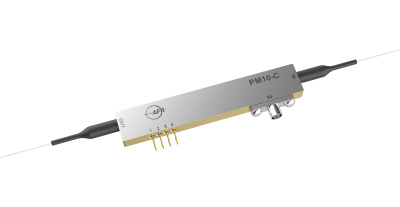
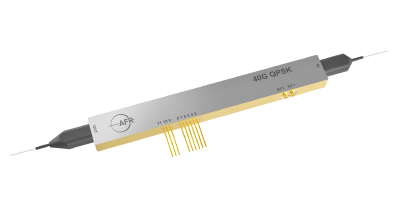
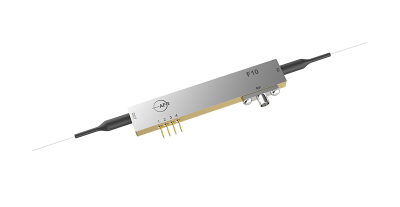
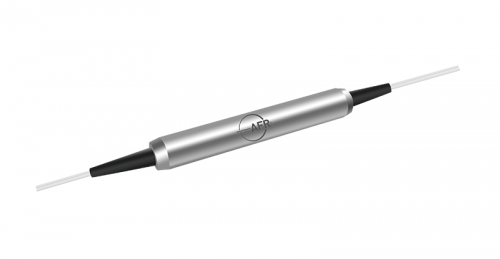
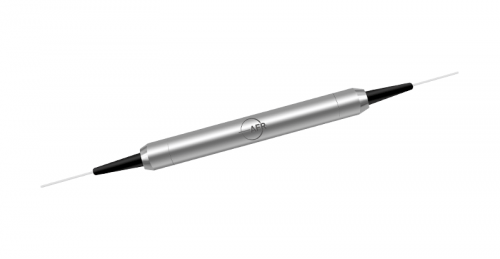
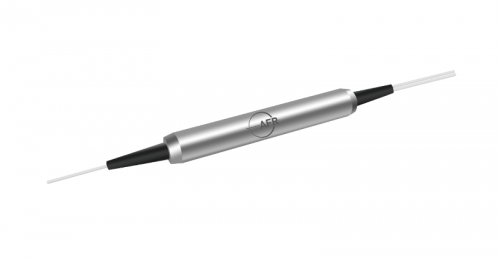
The 2 × 2 Polarization Maintaining Optical Circulator is a compact, high performance lightwave component that routes incoming signals from Port 1 to Port 2, incoming Port 2 signals to Port 3, and incoming Port 3 signals to Port 4. The optical circulator provides high isolation, low insertion loss, high extinction ratio, and excellent environmental stability.
AFR’s High Power Fiber to Free-Space Isolator (HPFSI) is the best choice for high power industrial pulse fiber lasers. With unique, patented technology, the power handling capacity was elevated to 500 W average laser power, and with very competitive cost-effectiveness.
The Multimode Pump Protector is a micro optic device based on environmentally stable thin-film filter technology. It is used to block out unwanted noise signals in multimode fiber communication systems. The components are characterized with high isolation, low insertion loss, high return loss, excellent environmental stability and high power handling capability.
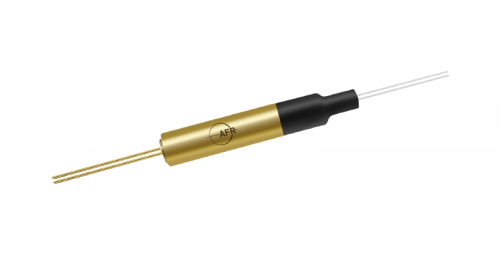
The Unidirectional Integrated Tap Photodiode (UTPD) integrates the functionality of an optical coupler and a photodiode for optical network's power detection. The unidirectional feature allows the PD to respond to power from input port only. It can be applied for channel power monitoring in DWDM system, in-line optical network switching protection monitoring (OLP), reconfigurable optical add/drop multiplexers (ROADM), and gain/attenuation monitoring in EDFAs, network's power detection, etc.
The Dense Wavelength Division Multiplexer series is designed and manufactured based on Telcordia standard and ITU standard.The devices use environmentally stable thin film filter and advanced packaging technology to achieve wide passband, low insertion loss, high channel isolation and excellent environmental stability. They can be used to perform single channel add or drop function or can be cascaded into sequence for multi-channel applications in DWDM systems.